
Concrete recycling is rapidly becoming a must-have practice on construction and demolition sites rather than a niche “green” option. With rising disposal fees, stricter regulations, and growing demand for sustainable building materials, concrete recycling offers a practical way to cut project costs, free up landfill space, and support a circular economy—all while maintaining performance and safety standards.
This guide explains how concrete recycling works, the financial and environmental benefits, what the process looks like on-site and off-site, and how contractors, developers, and property owners can implement it efficiently.
What is concrete recycling?
Concrete recycling is the process of taking waste concrete from demolition, renovation, or construction activities and processing it into new, usable aggregate and fill materials instead of sending it to landfill.
Typical sources of recyclable concrete include:
- Demolished buildings, bridges, and pavements
- Returned ready-mix concrete from batch plants
- Concrete from road repairs and infrastructure upgrades
- Precast concrete waste and offcuts
Once processed, this recycled concrete aggregate (RCA) can be used in road base, subbase layers, backfill, drainage applications, and, in some cases, even as partial aggregate replacement in new concrete mixes.
Why concrete recycling matters: Cost and landfill savings
Direct cost savings
Disposing of concrete as waste is expensive. You pay to haul it and pay again for tipping fees at the landfill or transfer station. Concrete recycling can substantially reduce both:
- Lower tipping fees: Many recycling facilities charge significantly less per ton than landfills—or even accept clean concrete at no cost in some areas.
- Reduced hauling distances: If you recycle on-site or use a nearby recycler, you can cut fuel, labor, and vehicle wear-and-tear.
- Material savings: Purchasing virgin aggregate, road base, or fill material adds up quickly. Recycled concrete products often cost 10–30% less than comparable quarried materials, depending on your region and quality specs.
For large demolition or infrastructure projects, the combination of lower disposal costs and cheaper material inputs can result in substantial savings on the overall budget.
Indirect and long-term financial benefits
On top of the obvious cost reductions, concrete recycling can generate additional value:
- Competitive bids: Contractors who reuse on-site materials can bid more aggressively while maintaining margins.
- LEED and green building credits: Recycling and using recycled content can contribute to certification targets, making your project more attractive to environmentally focused owners.
- Reduced risk of future compliance costs: As landfill regulations tighten and disposal fees rise, established recycling practices protect your operations from sudden cost spikes.
Environmental and regulatory benefits
Preserving landfill space
Concrete is bulky and heavy. When it hits the landfill, it occupies significant volume for a material that doesn’t decompose. By diverting concrete to recycling facilities, projects reduce strain on local landfills, extending their usable life and reducing the need for new disposal sites.
Conserving natural resources
Using recycled concrete aggregate reduces demand for virgin aggregate quarried from pits and mountainsides. This translates into:
- Less habitat disruption
- Lower energy use and emissions from extraction and transport
- Reduced pressure on local communities near quarry operations
According to the U.S. Environmental Protection Agency, construction and demolition materials—including concrete—account for hundreds of millions of tons of waste each year, much of which can be recovered and reused (source: U.S. EPA).
Compliance with regulations and project requirements
In many regions, regulations now encourage or require some level of construction and demolition waste diversion. Concrete recycling helps:
- Meet municipal diversion targets or disposal bans on clean fill
- Comply with state/province or national recycling mandates
- Align with public-sector procurement policies that favor recycled content
For public works, infrastructure, and institutional projects, a documented recycling plan often isn’t optional—it’s a bid requirement.
How the concrete recycling process works
1. Collection and separation
The process starts by collecting concrete from demolition or construction activities. Effective separation is key:
- Remove contaminants: Steel reinforcement, wood, plastic, asphalt, and general debris should be separated as thoroughly as possible.
- Keep it “clean”: The cleaner the concrete stream, the higher its value and the more end-use options you’ll have.
Rebar and wire mesh don’t disqualify concrete from recycling, but they must be removed during processing.
2. Size reduction: Breaking and crushing
Once collected, the concrete is reduced in size using heavy equipment:
- Primary breaking: Excavators with hydraulic breakers or shears break large slabs into manageable pieces.
- Primary crushing: A jaw crusher or impact crusher reduces pieces to smaller, more uniform sizes.
For on-site recycling, portable crushers and screens can be brought directly to the jobsite, minimizing transport.
3. Screening and cleaning
After initial crushing, the material is:
- Screened: To separate different size fractions (e.g., fines, gravel-sized, and larger pieces).
- Cleaned and processed: Magnetic separators and other equipment remove rebar and metallic pieces; additional screening or air classification may remove residual contaminants.
The goal is to produce a stable, well-graded aggregate that meets applicable specifications.
4. Grading and quality control
Recycled concrete aggregate is typically sorted into standard sizes (e.g., 3/4-inch minus, 1-1/2-inch minus, fines). Reputable recyclers perform basic quality tests such as:
- Gradation (particle size distribution)
- Los Angeles abrasion or similar durability tests
- Contaminant content checks
For structural applications or use in new concrete, more rigorous testing and specification compliance are required.
Common uses for recycled concrete
Recycled concrete is surprisingly versatile. Some of the most common applications include:
- Road base and subbase: One of the primary uses, providing a stable foundation for highways, parking lots, and access roads.
- General fill and embankment material: Cost-effective fill for grading and raising site elevations.
- Driveways and pathways: Crushed concrete is often used as a gravel alternative.
- Drainage layers: Larger recycled aggregates can work well in drainage and erosion control applications.
- Pipe bedding: Properly graded RCA can be used beneath utilities in some jurisdictions.
- Recycled-content concrete mixes: In suitable conditions, RCA can replace a portion of natural aggregate in new concrete.
Always check local codes and project specifications, as allowable uses and required performance standards can vary.
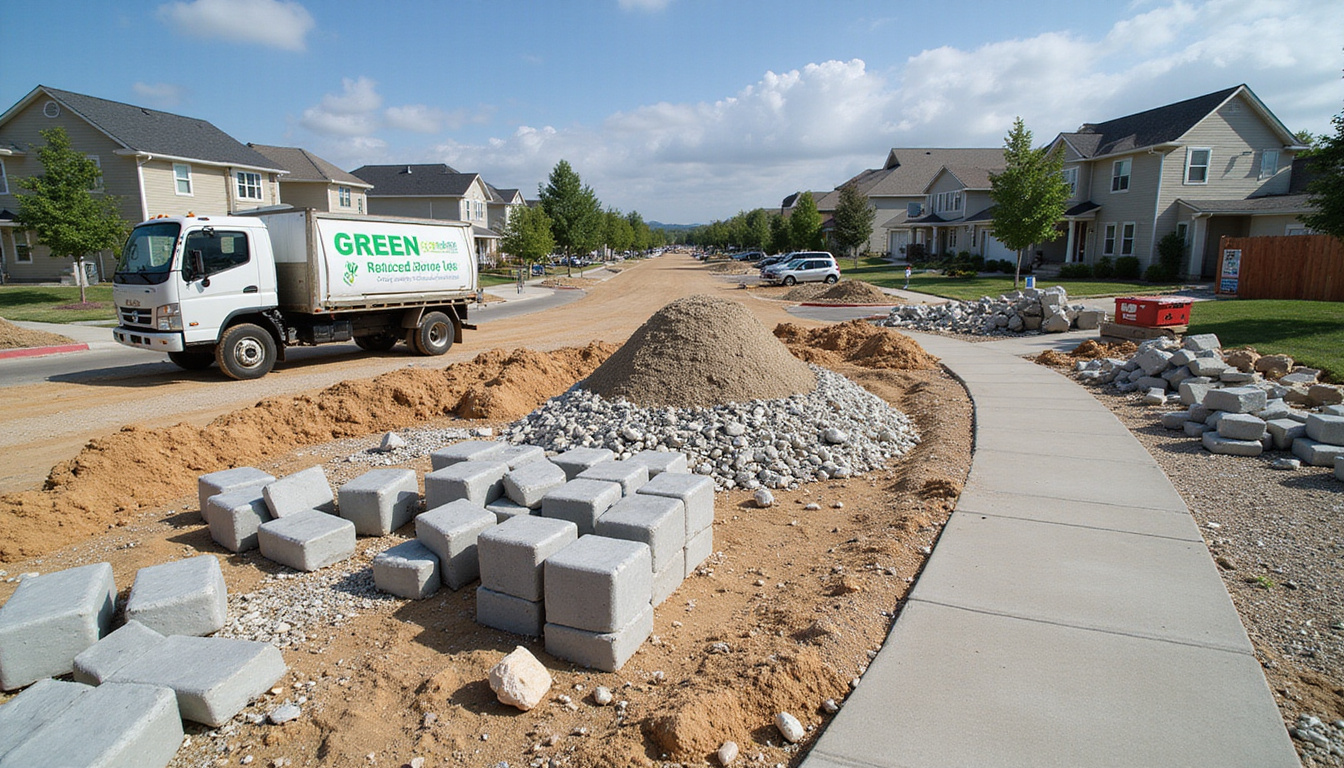
On-site vs off-site concrete recycling
On-site recycling
On larger projects, mobile crushers and screens can be set up on-site. Advantages include:
- Significant savings in hauling and disposal fees
- Immediate availability of base and fill materials
- Reduced truck traffic in and out of the site
- Greater control over logistics and scheduling
On-site recycling is especially attractive for roadwork, large parking lots, industrial sites, and phased demolition projects where there is enough volume to justify the equipment and setup.
Off-site recycling at a facility
For smaller jobs, tight sites, or projects without sufficient volume, sending concrete to an off-site recycler is usually more practical. Benefits include:
- Lower tipping fees than landfills
- Access to professionally processed, certified materials
- No need to mobilize specialized equipment
Some facilities also offer concrete pickup services or backhaul options, further simplifying logistics.
Planning concrete recycling on your project
To get the most value from concrete recycling, incorporate it into your project planning rather than treating it as an afterthought.
1. Assess volumes and material streams
Estimate how much concrete will be generated and whether it will be clean or mixed with other debris. Key questions:
- Is there enough volume to justify on-site processing?
- How many phases of demolition or construction will occur?
- What other materials (steel, brick, asphalt) will be generated alongside the concrete?
2. Identify end uses early
Determine potential uses for recycled concrete on or near the project:
- Road base or subbase for new surfaces on site
- Structural or non-structural fill
- Temporary access roads, laydown areas, or work platforms
Align your recycling plan with the project’s civil design so that the RCA produced meets the required specs for thickness, compaction, and drainage.
3. Select qualified recyclers or equipment providers
If you’re using an off-site facility:
- Verify certifications, testing practices, and quality control.
- Confirm the types of products they can produce and their typical lead times.
- Ask about contamination limits and tipping requirements.
If you’re doing on-site recycling:
- Work with experienced contractors or equipment providers.
- Confirm power, fuel, and space requirements.
- Arrange for material testing if the recycled product will serve critical functions.
4. Train crews on sorting and handling
Laborers and operators should understand:
- How to separate clean concrete from mixed debris
- What materials are not acceptable for recycling streams
- Safe handling procedures around crushers and heavy equipment
Good sorting at the source improves recycling efficiency and material quality.
Overcoming common concerns about concrete recycling
“Will recycled concrete perform as well as virgin aggregate?”
For many applications—especially road base, subbase, and general fill—properly processed RCA performs comparably to virgin aggregate. Numerous transportation departments publish specifications allowing RCA in highway and municipal projects.
Structural concrete applications are more complex and require strict quality control, but partial replacement of natural aggregate is increasingly common in non-critical elements.
“Is concrete recycling always cheaper?”
Usually, but not in every single case. Factors include:
- Distance to the nearest recycler vs landfill
- Site access and hauling logistics
- Volume and cleanliness of the concrete
- Availability and price of local virgin aggregates
A simple cost comparison that includes disposal, hauling, and material purchasing will reveal whether recycling is the best economic option. For medium and large projects, it usually is.
“Is it worth it for small jobs?”
Even for small projects, sending concrete to a recycler rather than landfill can reduce tipping fees and environmental impact. If you don’t need recycled material back, you still benefit from lower disposal costs and better compliance with local sustainability expectations.
Practical tips to maximize the benefits of concrete recycling
- Plan early: Include recycling targets and logistics in your pre-construction and demolition plans.
- Keep concrete clean: Avoid mixing concrete with general trash, soil, or hazardous material.
- Stage materials efficiently: Designate clear, accessible stockpile areas for recyclable concrete.
- Coordinate hauling: Use backhaul opportunities—deliver waste concrete to a recycler and return with RCA when possible.
- Document your recycling: Track tonnages, diversion rates, and recycled content for project reporting and marketing.
FAQ about concrete recycling
Q1: What is concrete waste recycling and how is it different from disposal?
Concrete waste recycling involves processing demolished or excess concrete into new aggregates instead of sending it to a landfill. Unlike simple disposal, recycling recovers value from the material, reduces tipping fees, and creates usable products like road base and fill.
Q2: Can recycled concrete aggregate replace natural stone in all applications?
Recycled concrete aggregate can replace natural stone in many uses, including road base, subbase, and non-structural fill. For high-strength structural concrete, bridge decks, or heavily loaded slabs, its use depends on local codes, specifications, and rigorous testing. Engineers often allow partial replacement where performance data supports it.
Q3: Is on-site concrete rubble recycling practical for residential projects?
On-site recycling with crushers is usually more economical for larger commercial, industrial, or public works projects. For typical residential demolitions, the volume is often too low to justify mobile crushing, but sending rubble to an off-site recycler is still practical and cost-effective compared to landfilling.
Start integrating concrete recycling into your next project
Every load of concrete you divert from landfill saves money, conserves landfill space, and reduces the environmental footprint of your project. Whether you’re handling a small building demo or a major infrastructure upgrade, a thoughtful concrete recycling plan can cut disposal and material costs, improve bid competitiveness, and help meet regulatory and sustainability goals.
If you’re planning a project with significant concrete work—demolition, road replacement, or large-scale site development—talk with local recyclers, civil engineers, and waste management partners now. Build recycling into your specifications, schedule, and budget so you can capture the full financial and environmental benefits from day one.
Junk Guys Inland Empire
Phone: 909-253-0968
Website: www.mediumspringgreen-snake-472026.hostingersite.com
Email: junkguysie@gmail.com
