
Commercial recycling isn’t just about feeling good or meeting regulations—it can directly improve your bottom line. When done strategically, commercial recycling reduces disposal costs, unlocks new revenue streams, and strengthens your brand with customers who care about sustainability.
Below are practical, no-fluff hacks you can apply in almost any business—whether you run an office, warehouse, restaurant, retail store, or manufacturing facility—to cut waste and increase profits at the same time.
Why commercial recycling is a profit lever, not just a cost
Many companies still see recycling as an added expense or a compliance box to tick. In reality, commercial recycling delivers measurable financial benefits when managed as a business process rather than an afterthought.
Key profit drivers include:
- Lower landfill and hauling fees
- Revenue from selling recyclables
- Reduced purchasing costs through reuse and right-sizing
- Tax incentives and grants in some regions
- Stronger brand reputation and customer loyalty
According to the U.S. EPA, recycling and reuse activities already support hundreds of thousands of jobs and tens of billions of dollars in wages and tax revenue in the U.S. alone (source: EPA Recycling Economic Information). When you tap into effective commercial recycling, you’re plugging into that larger economic engine.
Step 1: Conduct a simple waste audit (and find “hidden money”)
Before you overhaul anything, you need to know what you’re throwing away and what it’s costing you.
How to run a quick waste audit
You don’t need a consultant to get started. Over 1–2 weeks:
-
Collect sample data. Have staff or janitorial teams record:
- What’s in each trash bin and recycling bin
- Approximate volume or weight for main waste types (cardboard, paper, plastics, organics, metals, etc.)
- Pick-up frequency and bin fullness at each service
-
Pull cost data. Review:
- Monthly invoices for waste and recycling hauling
- Contamination surcharges or overage fees
- Rental fees for compactors, balers, or dumpsters
-
Identify your “Top 3” waste streams. Most businesses discover that:
- Corrugated cardboard
- Mixed office paper
- Mixed plastics (bottles, packaging)
account for most of the volume and cost.
-
Estimate revenue potential. Contact at least two local recyclers or brokers and ask what they’ll pay (if anything) for your top materials, at your volumes.
This simple audit often reveals you’re paying to throw away materials that could be recycled for free—or even sold.
Step 2: Right-size your bins and pickup schedule
One of the fastest commercial recycling “hacks” is adjusting container sizes and pickup frequency to match reality.
Cut waste costs with smarter container management
-
Downsize trash, upsize recycling.
If your trash dumpsters are half-empty on pickup days while recycling is overflowing, you’re literally paying to haul air. Reduce trash container size and increase recycling capacity. -
Reduce pickup frequency where possible.
Once recycling is optimized, many businesses can:- Move from 3x/week to 2x/week trash pickup
- Switch from multiple small bins to fewer, larger containers
-
Consolidate streams.
Instead of small bins everywhere, centralize:- One landfill/trash station
- One multi-stream recycling station
- One organics/food waste station (where applicable)
These tweaks often save 10–30% on monthly waste hauling without any change in actual waste generation—just better routing.
Step 3: Focus on “high-value” recyclables first
Not all recyclables deliver the same financial return. Start with materials that are clean, abundant, and relatively easy to market.
Profitable targets in commercial recycling
-
Cardboard (OCC)
- Common in retail, e‑commerce, distribution, and offices.
- Flatten and bale where volumes justify; baled cardboard usually commands better prices.
-
Metals (aluminum, steel, copper, etc.)
- Very high recycling value, especially in manufacturing and construction.
- Segregate metals by type if possible and partner with a reputable scrap metal dealer.
-
High-quality office paper and mixed paper
- Shred sensitive documents, but keep shredding minimal; over-shredding lowers fiber value.
- Collect in centralized bins away from contamination (e.g., food, coffee).
-
Clear PET and HDPE plastics
- Bottles, jugs, and clean rigid plastics are generally easier to market than mixed films.
- Avoid mixing with food-soiled containers to keep loads clean.
By targeting your top-value streams first, you demonstrate quick wins and build momentum for a broader commercial recycling program.
Step 4: Turn waste into a revenue stream
Many companies don’t realize they can sell recyclables once they reach a certain volume and quality threshold.
Ways to monetize your recyclables
-
Negotiate revenue sharing with your hauler.
Instead of “free” recycling, ask for:- A per-ton rebate on specific sorted materials
- A revenue split above a floor market price
-
Work with a recycling broker or processor.
For large volumes of cardboard, paper, or plastics, a broker may:- Provide balers or compactors at low or no cost
- Arrange direct mill or processor pickups
-
Direct sale or donation of reusable materials.
Consider:- Pallets, crates, and drums
- Furniture, fixtures, and IT equipment
- Overruns, seconds, or off-spec items
These can be sold via local buyers, online marketplaces, or donated (and potentially used for tax deductions—consult a tax professional).
When you treat recyclables as secondary commodities instead of “trash,” commercial recycling transforms from a cost center into a profit contributor.
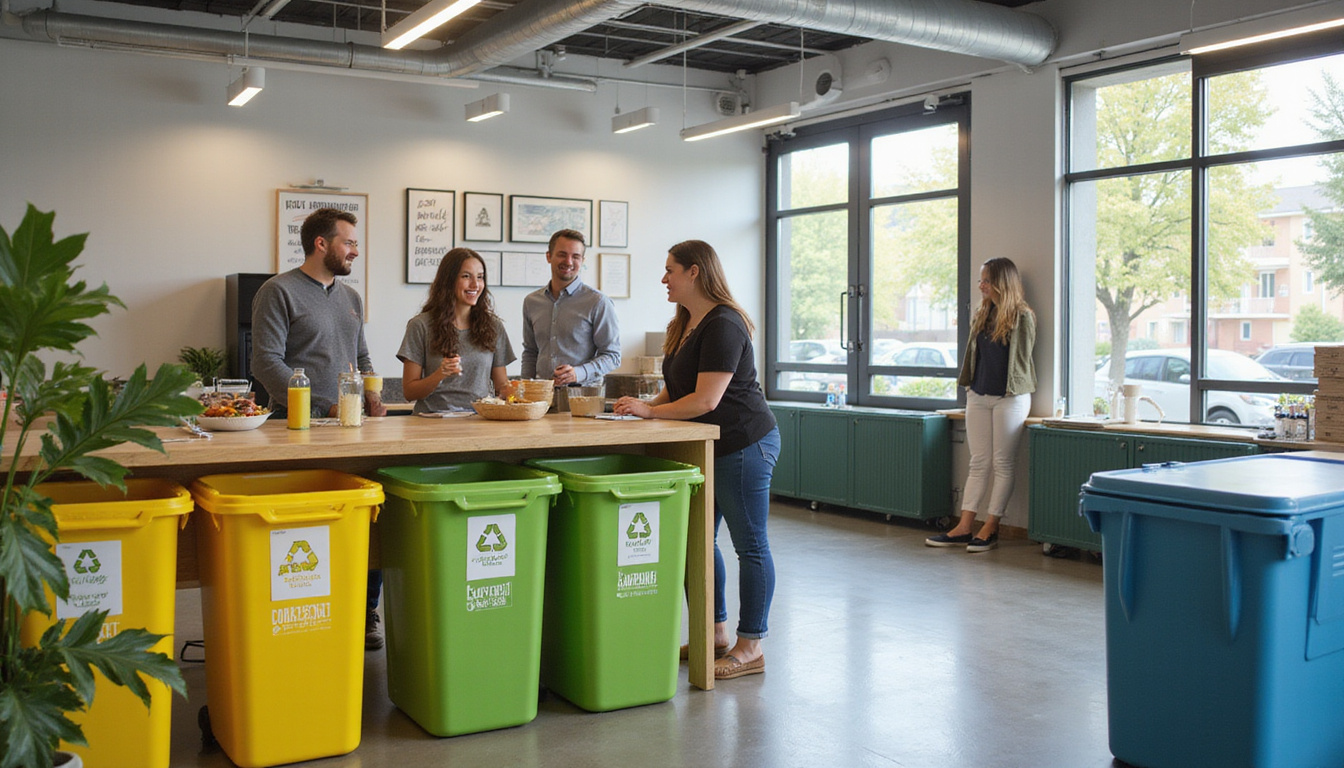
Step 5: Tackle contamination with smart, simple design
Contamination—trash in recycling or vice versa—is a top reason commercial recycling programs fail or cost more than they should.
Design your system for “no-brainer” sorting
Use clear, visual cues:
-
Consistent color coding.
- Blue: Recycling
- Green: Organics/compost
- Black or gray: Landfill/trash
-
Photo-based signage.
Show actual items used in your workplace (e.g., “Your coffee cup goes here,” with your brand’s cup in the image). -
Co-located bins.
Always place landfill and recycling (and organics, if used) together. Single trash bins alone invite contamination. -
Positive defaults.
Put recycling bins slightly closer or more prominent than trash. People tend to choose the most visible/accessible option.
Reducing contamination improves material value, avoids surcharges, and builds trust with your recycling partners.
Step 6: Train your team and tie recycling to performance
People make or break any commercial recycling program. You don’t need hours of training—just consistent, targeted communication.
Keep staff engagement simple and practical
-
Integrate into onboarding.
Give every new employee a one-page recycling guide and 5-minute walkthrough during orientation. -
Use quick micro-trainings.
- One slide or poster per month tackling a single issue (e.g., “No plastic bags in recycling”).
- 2-minute reminders during shift meetings.
-
Track and share results.
Post monthly updates:- Tons recycled vs. landfilled
- Cost savings or revenue from recycling
- Any goals met (“We reduced trash pickups by 20% last quarter”).
-
Incentivize improvements.
- Recognize teams or locations with the lowest contamination.
- Offer small rewards tied to measurable outcomes (e.g., reduced trash weight, new revenue).
A culture that understands and supports commercial recycling will keep your system running smoothly long term.
Step 7: Add organics and food waste diversion (where it pays off)
For restaurants, hotels, grocery stores, food manufacturers, and large offices, organics can be a major cost driver—and a huge opportunity.
Smart strategies for food waste recycling
-
Separate pre-consumer and post-consumer waste.
- Pre-consumer (kitchen prep scraps) is usually cleaner and easier to compost or send to anaerobic digestion.
- Post-consumer (plate scrapings) may need different handling.
-
Look for local composting or digester facilities.
Many accept:- Food scraps
- Soiled paper (napkins, paper towels)
- Certified compostable serviceware (if clearly labeled and truly accepted by the facility)
-
Explore food recovery.
Safe, unsold food may be:- Donated to food banks or charities
- Sold at a discount via apps or secondary channels
In some regions, diverting organics can significantly reduce landfill fees and meet emerging regulatory requirements for commercial recycling of food waste.
Step 8: Use data and technology to keep improving
Once your basic systems are in place, use data to avoid backsliding and find new efficiencies.
Metrics that matter for commercial recycling
Track, at minimum:
-
Tons or cubic yards of:
- Landfill waste
- Recyclables (by major material)
- Organics (if applicable)
-
Total monthly spend on:
- Landfill service
- Recycling service
- Any rebates or recycling revenue
Review this data quarterly to:
- Identify locations or departments with high contamination or high landfill volumes
- Justify capital investments (e.g., a baler that pays back in 18 months)
- Set realistic, incremental improvement targets
Some haulers and third-party platforms offer dashboards and even AI image monitoring of waste streams. Use these tools where they deliver clear value, but don’t wait for “perfect tech” to start.
Quick checklist: High-impact commercial recycling hacks
Use this list as a fast reference when building or upgrading your program:
- Run a basic waste and cost audit.
- Resize trash and recycling containers and adjust pickup frequency.
- Prioritize high-value streams (cardboard, metals, quality paper, PET/HDPE plastics).
- Negotiate rebates or revenue sharing for sorted recyclables.
- Design clear, co-located, color-coded bins with photo signage.
- Train staff briefly but consistently and share results.
- Add organics and food recovery where volumes justify it.
- Track key metrics and review them quarterly.
Implementing even half of these can move your commercial recycling from a compliance obligation to a competitive advantage.
FAQ: Commercial recycling for businesses
1. What is commercial recycling and how is it different from residential?
Commercial recycling is the collection, sorting, and processing of recyclables generated by businesses and organizations rather than households. It typically involves larger volumes, more homogeneous material streams (like cardboard or office paper), and negotiated service contracts. Because of scale, commercial recycling offers more opportunities to reduce costs and even generate revenue than typical residential recycling.
2. How can small businesses benefit from business recycling programs?
Even small businesses can benefit by:
- Right-sizing their trash and recycling containers
- Focusing on easy wins like cardboard and paper
- Sharing recycling services with nearby tenants or businesses in the same building
Over time, reduced landfill pickups and better recycling contracts can offset or surpass the cost of adding business recycling services.
3. What materials are most profitable for corporate recycling programs?
For many corporate recycling initiatives, the most valuable materials are corrugated cardboard, metals, high-quality office paper, and clean PET/HDPE plastics. In some sectors, electronics and IT equipment also offer strong resale or refurbishment value. Corporate recycling programs that separate these materials at the source and maintain low contamination typically see the best financial returns.
Turn your waste into a strategic asset
Every dumpster on your property is either a silent cost drain or a hidden profit center. By approaching commercial recycling with the same discipline you apply to purchasing, logistics, or sales, you can cut operating expenses, unlock new revenue, and strengthen your brand’s sustainability story.
If you’re ready to transform your waste stream into a competitive advantage, start with a simple audit, pick one or two high-impact hacks from this guide, and implement them this quarter. Then, expand from there.
Need help designing or optimizing a commercial recycling program tailored to your industry, locations, and volumes? Reach out to a qualified recycling consultant or service provider and use this playbook as your roadmap for asking the right questions—and getting the best possible deal for your business and the planet.
Junk Guys Inland Empire
Phone: 909-253-0968
Website: www.mediumspringgreen-snake-472026.hostingersite.com
Email: junkguysie@gmail.com
